The #1 Mistake Teachers Make When Teaching Counting in Preschool (and How to Teach Counting the Right Way)
Do you have toddlers in your class proudly counting, “1, 2, 3, 7, 9, 14!” Or preschoolers who count objects but when you ask, “How many?” they give you a random number or start counting all over again?
There’s a reason for this. Counting isn’t just one skill. It’s actually three separate skills that build on each other. Just like kids need to crawl before they walk (there is a developmental progression), children need to master certian counting skills before others (there is a developmental progression). When we skip ahead, they get frustrated and confused.
#1 mistake I see teachers make when teaching counting:
Asking children “How many?” before they are ready.
Let’s break down how counting really develops, what each stage looks like, and the best activities for teaching counting in preschool the right way.
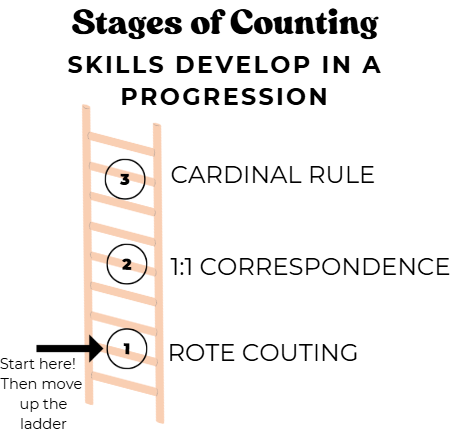
Stage 1: Rote Counting (Learning the Names of Numbers)
Before a child can understand what numbers mean, they have to learn the names of numbers in order. This is called rote counting, saying "one, two, three, four, five" without counting anything.
The only way to master rote counting: Practice, practice, practice and repetition, repetition, repetition.
Activities to Practice Rote Counting
For all children:
Songs & rhymes: "One, Two, Buckle My Shoe," "Five Little Ducks," "Five Little Monkeys"
Routine counting: Count while walking down the hall, lining up, washing hands, going up or down stairs, during potty breaks, just start counting!
For children who've mastered basic rote counting (1-10): Add more challenging sequences:
Count backwards: Start with 3, 2, 1, then work up to 5, 4, 3, 2, 1, then 10, 9, 8, 7...
Start from random numbers: "Can you count starting from 6? Six, seven, eight..."
Skip counting: Count by twos (2, 4, 6, 8) or fives (5, 10, 15, 20)
For toddlers or preschoolers still mixing up numbers while rote counting:
Keep adding counting to your daily routines- they need to hear that number sequence a. lot.
Count silly, count loud, count soft, count fast, count slow- just keep counting!
Remember: Rote counting alone doesn't mean a child can actually count objects. That comes next, in stage 2!
Stage 2: One-to-One Correspondence (Matching Words to Objects)
One-to-one correspondence means the child touches or moves one object for each number word they say: "One" (touches block), "two" (touches another block), "three" (touches another).
🚨 This is the stage some teachers accidentally skip or move to stage 3 too soon.
Here's what happens: A teacher says, "Count the blocks." The child rote counts or sort of one-to-one counts, and then the teacher asks, "How many?" (and of course the child gets it wrong). If children haven't mastered one-to-one correspondence, the question "How many?" doesn't make sense to them yet. (It’s like asking a baby to go from crawling to walking and you skipped standing)
At this stage, counting becomes about THINGS, not just words. Children are learning that each number word matches exactly one object. This is HARD work, and kids need a lot of time practicing and mastering this skill!
Activities To Practice One-to-One Correspondence
Count & Move: Move blocks from one pile to another while counting
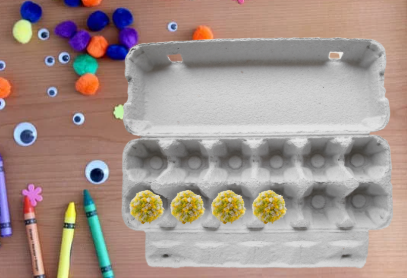
Muffin Tins or Egg Cartons: Drop one object into each space as you count
Tactile Counting: High fives, stomps, or claps while saying each number
Modeling Language: When you finish counting, model: “1, 2, 3, 4, 5, 6, 7. SEVEN! You have SEVEN grapes.”
Teacher Tip: If children count too fast and lose track, slow them down by guiding them to touch or move each object as they count. Physical movement makes the concept concrete.
Stage 3: Cardinality (The “How Many” Rule)
This is the aha! moment. The cardinal rule is the understanding that the last number counted tells how many objects are in the group. This is when counting becomes truly meaningful. After counting “1, 2, 3, 4, 5,” the child understands that the last number they say (“Five”) represents the total number in the group.
This is the foundation for all future math and a huge milestone!
Activities to Practice Cardinality
“How Many Did You Get?”: Count blocks or animals, then emphasize the total: “There are FOUR blocks.”
Mystery Bag: Pull out items, count, and state the total
Story Problems in Play: “You fed three animals. How many got food?”
Give Me Games: “Can you give me 3 crayons?” or “Put 4 bears in this basket.”
Number Hunts: “Find 3 red things.” or “Bring me 6 blocks.”
Teacher Tip: If the child is not able to answer “How many?” and gives a random number or starts counting again, go back to 1:1 correspondence and model lots of you answering the question. It will sound like this: “Lets count. 1. 2. 3. 4. 5. 6. Six! Six cats! How many? Six!”
The Bottom Line: Meet Them Where They Are
You can't rush the counting progression (just like you cant rush a child learning to walk).
A child who hasn't mastered rote counting can't do one-to-one correspondence
A child who can't do one-to-one correspondence won't understand cardinality “How many?”
Counting is HARD. Give them lots of practice and supports at whatever stage they're at.
Approved CEUs Training
〰️
Approved CEUs Training 〰️
Looking for more resources on how to teach math to your infant, toddler, or preschool class? Join the training and turn everyday rountines into math language opportunities.